Schlagwort: Research
-

New resource to help teachers make Computing culturally relevant
Reading Time: 6 minutesHere at the Raspberry Pi Foundation, we believe that it’s important that our academic research has a practical application. An important area of research we are engaged in is broadening participation in computing education by investigating how the subject can be made more culturally relevant — we have published several studies in…
-
Using an AI code generator with school-age beginner programmers
Reading Time: 5 minutesAI models for general-purpose programming, such as OpenAI Codex, which powers the AI pair programming tool GitHub Copilot, have the potential to significantly impact how we teach and learn programming. The basis of these tools is a ‘natural language to code’ approach, also called natural language programming. This allows users to generate…
-

Supporting learners with programming tasks through AI-generated Parson’s Problems
Reading Time: 6 minutesThe use of generative AI tools (e.g. ChatGPT) in education is now common among young people (see data from the UK’s Ofcom regulator). As a computing educator or researcher, you might wonder what impact generative AI tools will have on how young people learn programming. In our latest research seminar, Barbara Ericson…
-
Grounded cognition: physical activities and learning computing
Reading Time: 4 minutesEveryone who has taught children before will know the excited gleam in their eyes when the lessons include something to interact with physically. Whether it’s printed and painstakingly laminated flashcards, laser-cut models, or robots, learners’ motivation to engage with the topic will increase along with the noise levels in the classroom. However,…
-

Integrating computational thinking into primary teaching
Reading Time: 6 minutes“Computational thinking is really about thinking, and sometimes about computing.” – Aman Yadav, Michigan State University Computational thinking is a vital skill if you want to use a computer to solve problems that matter to you. That’s why we consider computational thinking (CT) carefully when creating learning resources here at the Raspberry…
-
Culturally relevant Computing: Experiences of primary learners
Reading Time: 4 minutesToday’s blog is written by Dr Alex Hadwen-Bennett, who we worked with to find out primary school learners’ experiences of engaging with culturally relevant Computing lessons. Alex is a Lecturer in Computing Education at King’s College London, where he undertakes research focusing on inclusive computing education and the pedagogy of making. Despite…
-
Engaging primary Computing teachers in culturally relevant pedagogy through professional development
Reading Time: 8 minutesUnderrepresentation in computing is a widely known issue, in industry and in education. To cite some statistics from the UK: a Black British Voices report from August 2023 noted that 95% of respondents believe the UK curriculum neglects black lives and experiences; fewer students from working class backgrounds study GCSE Computer Science;…
-
Spotlight on teaching programming with and without AI in our 2024 seminar series
Reading Time: 3 minutesHow do you best teach programming in school? It’s one of the core questions for primary and secondary computing teachers. That’s why we’re making it the focus of our free online seminars in 2024. You’re invited to attend and hear about the newest research about the teaching and learning of programming, with…
-
Support for new computing teachers: A tool to find Scratch programming errors
Reading Time: 5 minutesWe all know that learning to program, and specifically learning how to debug or fix code, can be frustrating and leave beginners overwhelmed and disheartened. In a recent blog article, our PhD student Lauria at the Raspberry Pi Computing Education Research Centre highlighted the pivotal role that teachers play in shaping students’…
-

Young children’s ScratchJr coding projects: Assessment and support
Reading Time: 5 minutesBlock-based programming applications like Scratch and ScratchJr provide millions of children with an introduction to programming; they are a fun and accessible way for beginners to explore programming concepts and start making with code. ScratchJr, in particular, is designed specifically for children between the ages of 5 and 7, enabling them to…
-

Apply for a free UK teacher’s place at the WiPSCE conference
Reading Time: 3 minutesFrom 27 to 29 September 2023, we and the University of Cambridge are hosting the WiPSCE International Workshop on Primary and Secondary Computing Education Research for educators and researchers. This year, this annual conference will take place at Robinson College in Cambridge. We’re inviting all UK-based teachers of computing subjects to apply…
-

Running a workshop with teachers to create culturally relevant Computing lessons
Reading Time: 6 minutesWho chooses to study Computing? In England, data from GCSE and A level Computer Science entries in 2019 shows that the answer is complex. Black Caribbean students were one of the most underrepresented groups in the subject, while pupils from other ethnic backgrounds, such as White British, Chinese, and Asian Indian, were…
-

Introducing data science concepts and skills to primary school learners
Reading Time: 5 minutesEvery day, most of us both consume and create data. For example, we interpret data from weather forecasts to predict our chances of a good weather for a special occasion, and we create data as our carbon footprint leaves a trail of energy consumption information behind us. Data is important in our…
-
Integrating primary computing and literacy through multimodal storytelling
Reading Time: 5 minutesBroadening participation and finding new entry points for young people to engage with computing is part of how we pursue our mission here at the Raspberry Pi Foundation. It was also the focus of our March online seminar, led by our own Dr Bobby Whyte. In this third seminar of our series…
-

Supporting beginner programmers in primary school using TIPP&SEE
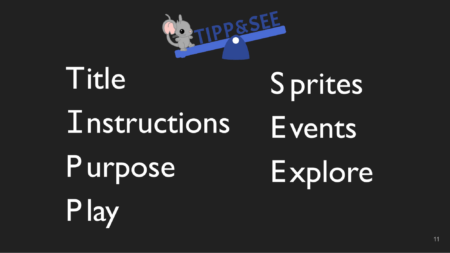
Reading Time: 5 minutesEvery young learner needs a successful start to their learning journey in the primary computing classroom. One aspect of this for teachers is to introduce programming to their learners in a structured way. As computing education is introduced in more schools, the need for research-informed strategies and approaches to support beginner programmers…
-

Combining computing and maths to teach primary learners about variables
Reading Time: 5 minutesIn our first seminar of 2023, we were delighted to welcome Dr Katie Rich and Carla Strickland. They spoke to us about teaching the programming construct of variables in Grade 3 and 4 (age 8 to 10). Dr Katie Rich Carla Strickland We are hearing from a diverse range of speakers in…
-
Gender Balance in Computing — the big picture
Reading Time: 7 minutesImproving gender balance in computing is part of our work to ensure equitable learning opportunities for all young people. Our Gender Balance in Computing (GBIC) research programme has been the largest effort to date to explore ways to encourage more girls and young women to engage with Computing. Commissioned by the Department…
-
Combining research and practice to evaluate and improve computing education in non-formal settings
Reading Time: 7 minutesIn the final seminar in our series on cross-disciplinary computing, Dr Tracy Gardner and Rebecca Franks, who work here at the Foundation, described the framework underpinning the Foundation’s non-formal learning pathways. They also shared insights from our recently published literature review about the impact that non-formal computing education has on learners. Dr…
-

Using relevant contexts to engage girls in the Computing classroom: Study results
Reading Time: 6 minutesToday we are sharing an evaluation report on another study that’s part of our Gender Balance in Computing research programme. In this study, we investigated the impact of using relevant contexts in classroom programming activities for 12- to 13-year-olds on girls’ and boys’ attitudes towards Computing. We have been working on Gender…
-
Spotlight on primary computing education in our 2023 seminar series
Reading Time: 4 minutesWe are excited to announce our next free online seminars, running monthly from January 2023 and focusing on primary school (K–5) teaching and learning of computing. Our seminars, having covered various topics in computing education over the last three years, will now offer you a close look at current questions and research…
-
Non-formal learning activities: What do we know and how do we apply it to computing?
Reading Time: 6 minutesAt the Raspberry Pi Foundation, we engage young people in learning about computing and creating with digital technologies. We do this not only by developing curricula for formal education and introducing tens of thousands of children around the world to coding at home, but also through supporting non-formal learning activities such as…
-

Building a maths curriculum for a world shaped by computing
Reading Time: 5 minutesIn the penultimate seminar in our series on cross-disciplinary computing, we were delighted to host Conrad Wolfram (European co-founder/CEO of Wolfram Research). Conrad Wolfram Conrad has been an influential figure in the areas of AI, data science, and computation for over 30 years. The company he co-founded, Wolfram Research, develops computational technologies…